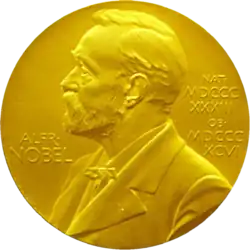
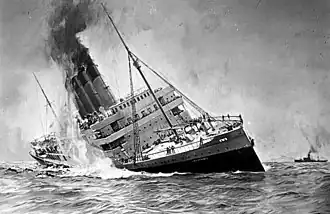
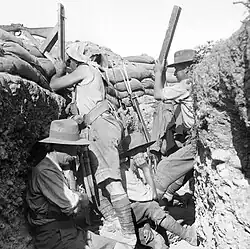
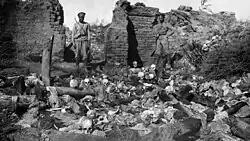
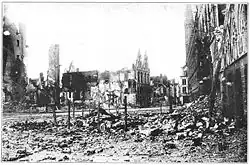
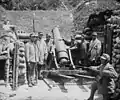
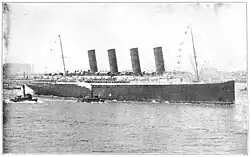
From top to bottom, left to right: The Sinking of the RMS Lusitania by a German U-boat kills nearly 1,200 people, including 128 Americans, heightening tensions between Germany and the United States; the Gallipoli campaign begins as Allied forces attempt an amphibious invasion of the Ottoman Empire, ending in failure; the Armenian genocide starts with the arrest, deportation, and mass extermination of up to 1.5 million Armenians; the Gorlice–Tarnów offensive breaks Russian lines in Galicia, shifting the Eastern Front in favor of the Central Powers; the Second Battle of Ypres marks the first large-scale use of poison gas on the Western Front; and Italy joins the Allies, opening the Italian Front against Austria-Hungary.
1915 (MCMXV) was a common year starting on Friday of the Gregorian calendar and a common year starting on Thursday of the Julian calendar, the 1915th year of the Common Era (CE) and Anno Domini (AD) designations, the 915th year of the 2nd millennium, the 15th year of the 20th century, and the 6th year of the 1910s decade. As of the start of 1915, the Gregorian calendar was 13 days ahead of the Julian calendar, which remained in localized use until 1923.
Events
Below, the events of World War I have the "WWI" prefix.
January – British physicist Sir Joseph Larmor publishes his observations on "The Influence of Local Atmospheric Cooling on Astronomical Refraction".[1]
WWI: Battle of Broken Hill: A train ambush near Broken Hill, Australia, is carried out by two men (claiming to be in support of the Ottoman Empire) who are killed, together with four civilians.
January 5 – Joseph E. Carberry sets an altitude record of 11,690 feet (3,560 m), carrying Capt. Benjamin Delahauf Foulois as a passenger, in a fixed-wing aircraft.
A Fool There Was premières in the United States, starring Theda Bara as a femme fatale; she quickly becomes one of early cinema's most sensational stars.
January 21 – Kiwanis is founded in Detroit, Michigan, as The Supreme Lodge Benevolent Order Brothers.
January 23 – Chilembwe uprising: Baptist minister John Chilembwe initiates an ultimately unsuccessful uprising against British colonial rule in Nyasaland (modern-day Malawi).
January 25 – The first United States coast-to-coast long-distance telephone call is facilitated by a newly invented vacuum tube amplifier, ceremonially inaugurated by Alexander Graham Bell in New York City and his former assistant Thomas A. Watson, in San Francisco, California.
WWI: The Ottoman Army begins the Raid on the Suez Canal.
The Rocky Mountain National Park is established by an act of the United States Congress.
January 27 – WWI: French military casualties begin arriving at the Hôpital Temporaire d'Arc-en-Barrois, established earlier in the month by British volunteers.
January 31 – WWI: Battle of Bolimów – Germany's first large-scale use of poison gas as a weapon occurs, when 18,000 artillery shells containing liquid xylyl bromide tear gas are fired on the Imperial Russian Army, on the Rawka River west of Warsaw; however, freezing temperatures prevent it being effective.[5]
February – While working as a cook at New York's Sloane Hospital for Women under an assumed name, "Typhoid Mary" (an asymptomatic carrier of typhoid fever) infects 25 people, and is placed in quarantine for life on March 27.
February 1 – William Fox creates the Fox Film Corporation.
February 4 – The Maritz Rebellion of disaffected Boers against the government of the Union of South Africa ends with the surrender of the remaining rebels.
March 10–13 – WWI: Battle of Neuve Chapelle – In the first deliberately planned British offensive of the war, British Indian troops overrun German positions in France, but are unable to sustain the advance.
March 11 – WWI: British armed merchantman HMS Bayano (1914) is sunk in the North Channel off the coast of Scotland by Imperial German NavyU-boatSM U-27. Around 200 crew are lost, a number of bodies being washed up on the Isle of Man, with only 26 saved.[7]
Battle of Más a Tierra: Off the coast of Chile, the British Royal Navy forces the Imperial German Navy light cruiser SMS Dresden (last survivor of the German East Asia Squadron) to scuttle.
British Royal Navy battleship HMS Dreadnought (1906) sinks German submarine U-29 with all hands in the Pentland Firth off the coast of Scotland by ramming her, the only time this tactic is known to have been successfully used by a battleship.
March 19 – Pluto is photographed for the first time, but is not recognised for what it is.
April 5 – Boxer Jess Willard, the latest "Great White Hope", defeats Jack Johnson with a 26th-round knockout in sweltering heat, at Havana, Cuba. Willard becomes very popular among white Americans, for "bringing back the championship to the white race".
April 21 – On the orders of Talat Pasha, Haydar Bey organized an expedition against the Assyrians. He killed thousands of Assyrians along with Kurdish tribes.
April 22 – WWI: Start of Second Battle of Ypres – Germany makes its first large scale use of poison gas on the Western Front.
April 24 – Armenian genocide: deportation of Armenian notables from Istanbul begins.
April 26 – Treaty of London: Italy secretly agrees to leave the Triple Alliance with Germany and Austria-Hungary, and join with the Entente Powers, in exchange for certain territories of Austria-Hungary on its borders.
May
May 1 – General Louis Botha, Prime Minister of South Africa, leads the army in the occupation of German South West Africa.
May 5 – WWI: Gallipoli Campaign – Forces of the Ottoman Empire begin shelling ANZAC Cove from a new position behind their lines.
Sinking of the RMS Lusitania: RMS Titanic's main rival, the British ocean linerRMS Lusitania, is sunk by Imperial German NavyU-boatU-20 off the south-west coast of Ireland, killing 1,199 civilians en route from New York City to Liverpool. The best-known of the celebrities on board is American sportsman Alfred Gwynne Vanderbilt (b. 1877).
May 9 – WWI – Second Battle of Artois: German and French forces fight to a standstill; German forces defeat the British at the Battle of Aubers Ridge.
May 17 – The last purely Liberal government in the United Kingdom ends, when the prime minister H. H. Asquith forms an all-party coalition government, the Asquith coalition ministry, effective May 25.
Quintinshill rail disaster in Scotland: The collision and fire kill 226, mostly troops, the largest number of fatalities in a rail accident in the United Kingdom.
Lassen Peak, one of the Cascade Volcanoes in California, erupts, sending an ash plume 30,000 feet in the air, and devastating the nearby area with pyroclastic flows and lahars. It is the only volcano to erupt in the contiguous United States this century, until the 1980 eruption of Mount St. Helens.
May 25 – China agrees to the Twenty-One Demands of the Japanese.
May 27 – Armenian genocide: The Tehcir Law is promulgated by the Turkish Ottoman Empire authorizing deportation of the Ottoman Armenian population to Deir ez-Zor in the Syrian desert, leading to the deaths of anywhere between 800,000 and over 1,500,000 civilians and confiscation of their property.[9]
May 28 – International Congress of Women meets at the Hague as a major peace initiative.[10]
May 29 – Teófilo Braga becomes president of Portugal.
June
June – Armenian genocide: 15,000 civilians from the Ottoman Armenian population of Bitlis are massacred by Ottoman Turks and Kurds.[11]
June 9 – U.S. secretary of state William Jennings Bryan resigns over a disagreement regarding his nation's handling of the sinking of the RMS Lusitania.
June 11 – Friar Leonard Melki and hundreds of other Christians are driven out of Mardin and massacred by Ottoman troops.[12]
June 16 – Women's Institutes are established in Britain.
Armenian genocide: 17,000 civilians from the Ottoman Armenian population of Trebizond are massacred by Ottoman Turks.[14]
July 1 – WWI: In aerial warfare, German fighter pilot Kurt Wintgens becomes the first person to shoot down another plane, using a machine gun equipped with synchronization gear.
An extremely overloaded International Railway (New York–Ontario) trolleycar with 157 passengers crashes near Queenston, Ontario, resulting in 15 casualties.
Sinhalese militia captain Henry Pedris is executed in British Ceylon for inciting race riots, a charge later proved false; he becomes a hero of the Sri Lankan independence movement.
July 9 – WWI: Theodore Seitz, governor of German South West Africa, surrenders to General Louis Botha, between Otavi and Tsumeb.
July 11 – WWI: Battle of Rufiji Delta – German cruiser SMS Königsberg (1905) is forced to scuttle in the Rufiji River, German East Africa (modern-day Tanzania).
July 14 – The McMahon–Hussein Correspondence between Hussein bin Ali, Sharif of Mecca and the British official Henry McMahon concerning the Arab revolt against the Ottoman Empire begins; in exchange for assistance against the Ottomans, the British offer bin Ali their recognition of an independent Arab kingdom, although clear terms are never agreed.[15]
July 22 – WWI: The "Great Retreat" is ordered on the Eastern Front; Russian forces pull back out of Poland (at this time part of the Russian Empire), taking machinery and equipment with them.
July 24 – Steamer Eastland capsizes in central Chicago, with the loss of 844 lives.
July 28 – The American occupation of Haiti (1915–34) begins.
August
August: Destruction by the 1915 Galveston hurricane.
August 6 – WWI: Battle of Sari Bair (Gallipoli Campaign) – The Allies mount a diversionary attack timed to coincide with a major Allied landing of reinforcements at Suvla Bay.
September 7 – Cartoonist John B. Gruelle is given a patent for his Raggedy Ann doll.
September 8 – WWI: A Zeppelin raid destroys No. 61 Farringdon Road, London; the premises are rebuilt in 1917, and called The Zeppelin Building.
September 11 – The Pennsylvania Railroad begins electrified commuter rail service between Paoli and Philadelphia, using overhead AC trolley wires for power. This type of system is later used in long-distance passenger trains between New York City, Washington, D.C., and Harrisburg, Pennsylvania.
September 12 – French soldiers rescue over 4,000 Armenian genocide survivors stranded on Musa Dagh, a mountain in the Hatay province of Turkey.
September 25–October 14 – WWI: Battle of Loos – British forces take the French town of Loos, but with substantial casualties, and are unable to press their advantage. This is the first time the British use poison gas in World War I, and also their first large-scale use of 'New' (or Kitchener's Army) units.
September 30 – WWI: Serbian Army private Radoje Ljutovac becomes the first soldier in history to shoot down an enemy aircraft, with ground-to-air fire.
October
October 12 – WWI: British nurse Edith Cavell is executed by a German firing squad, for helping Allied soldiers escape from Belgium.
October 21 – The United Daughters of the Confederacy holds its first annual meeting outside the South, in San Francisco. Historian General Mildred Rutherford addresses the gathering on the "Historical Sins of Omission & Commission", of Yankee historians.
October 23 – WWI: The torpedoing of armored cruiser SMS Prinz Adalbert (1901) results in only 3 men being rescued from a crew of 675, the greatest single loss of life for the Imperial German Navy in the Baltic Sea during the war.
October 28 – St. Johns School fire: Fire at St. John's School in Peabody, Massachusetts, United States, claims the lives of 21 girls between the ages of 7 and 17.
November
November 18 – The U.S. silent filmInspiration, the first mainstream movie in which a leading actress (Audrey Munson) appears nude, is released.
December 4–18 – The 'Peace Ship' Oscar II chartered by industrialist Henry Ford sails from Hoboken, New Jersey to Oslo on an independent and eventually unsuccessful mission to broker a peace conference.[21]
^"The Deportation of the Armenians of Dörtyol", Ciphered telegram from the Ministry of the Interior (Ottoman Empire) to the Province of Adana, BOA. DH. ŞFR, nr. 50/141.
^Einstein, Albert (November 25, 1915). "Die Feldgleichungen der Gravitation". Sitzungsberichte der Preussischen Akademie der Wissenschaften zu Berlin: 844–847. Bibcode:1915SPAW.......844E. Archived from the original on July 25, 2023. Retrieved August 27, 2018.
^"Dr. Tom Pashby". Canada's Sports Hall of Fame. 2000. Archived from the original on October 22, 2022. Retrieved October 26, 2022.
^Deborah Andrews (1991). Annual Obituary, 1990. St. James Press. p. 752. ISBN 978-1-55862-092-6. Archived from the original on December 7, 2023. Retrieved July 24, 2021.
^Barry Rivadue (1990). Alice Faye: A Bio-bibliography. Greenwood Publishing Group. p. 1. ISBN 978-0-313-26525-9. Archived from the original on December 7, 2023. Retrieved July 24, 2021.
^Rees, Philip (1990). Biographical Dictionary of the Extreme Right Since 1890. New York, New York: Simon & Schuster.
^Clifford M. Caruthers (1995). Letters of Ring Lardner. Orchises Press. p. 108. ISBN 978-0-914061-52-6. Archived from the original on December 7, 2023. Retrieved July 24, 2021.
^Brozović, Dalibor (1999). Hrvatska enciklopedija (in Croatian). Vol. 1. Zagreb, Croatia: Leksikografski zavod "Miroslav Krleža". p. 400. ISBN 978-9-53603-629-5.
^Andersen, Rune J. (December 10, 2014). "Knut Nystedt". In Helle, Knut (ed.). Norsk Biografisk Leksikon (in Norwegian). Oslo: Kunnskapsforlaget. Retrieved April 13, 2017.
^Graham Allen (June 2, 2004). Roland Barthes. Routledge. p. 1. ISBN 978-1-134-50340-7. Archived from the original on December 7, 2023. Retrieved July 24, 2021.
.jpg)








.jpg)
.jpg)
.jpg)

.jpg)
.jpg)

.jpg)





.jpg)
.jpg)